

Rose M.
Introduction
If you are researching extra living space in California, you have probably seen both terms: JADU vs ADU. Many homeowners are unsure about the difference because both are legal accessory housing units, but California treats them differently when it comes to size, owner-occupancy, layout, and permitting rules.
Understanding ADU vs JADU rules before starting a project can help you avoid planning the wrong type of unit for your property. In general, an ADU functions as a fully independent living space, while a JADU must be created within the existing primary home and follows stricter size limitations.
This guide explains the difference between ADU and JADU in plain English, including California-specific rules, a side-by-side comparison table, and which option may fit your property goals best.
Quick Answer: JADU vs ADU
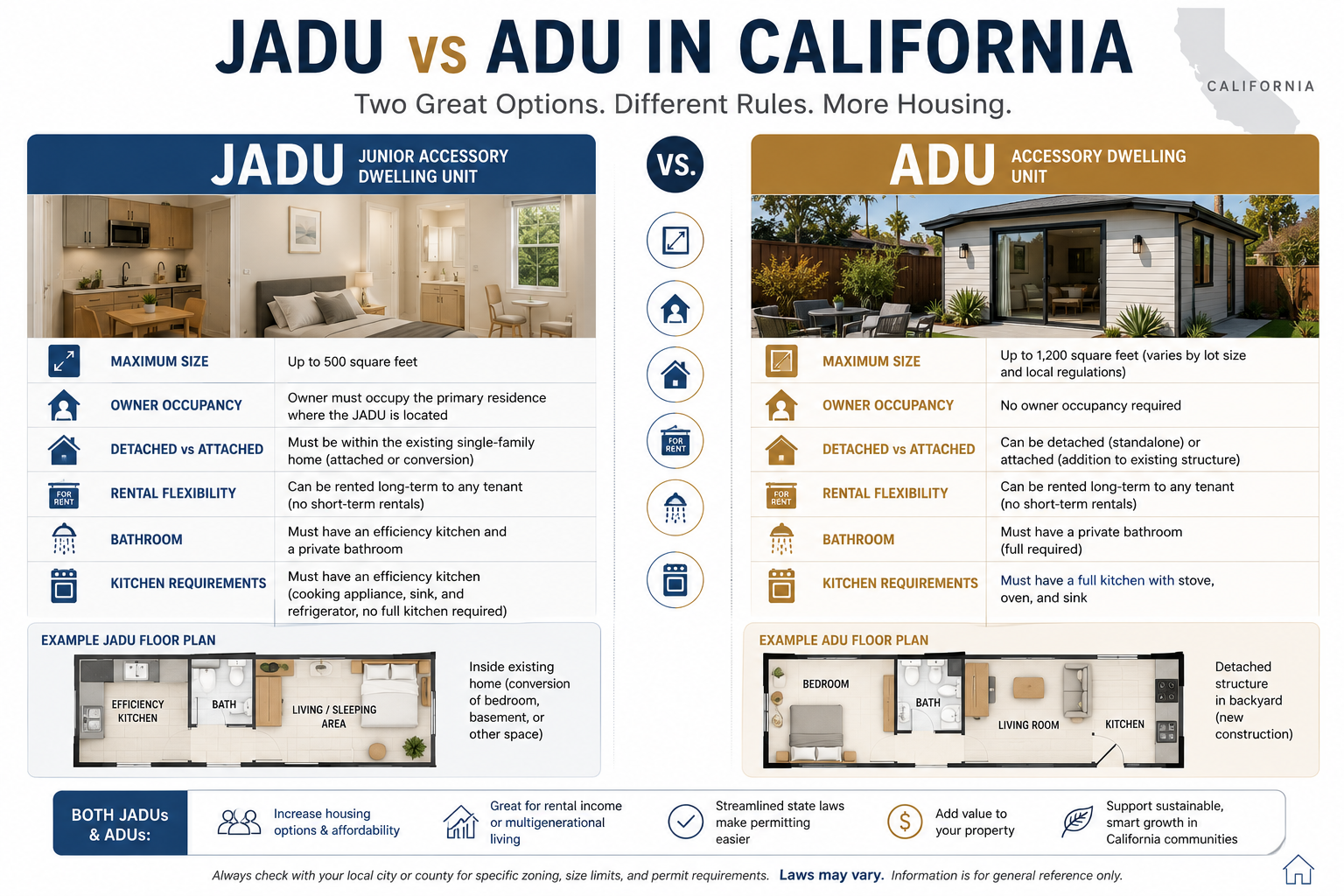
!Quick answer comparing JADU vs ADU
- A JADU must be created within the existing primary home and cannot exceed 500 square feet.
- An ADU can be detached, attached, or converted from existing space such as a garage.
- A JADU requires owner occupancy in California.
- An ADU functions as a fully independent housing unit with its own kitchen, bathroom, and entrance.
- In many California single-family zones, homeowners may be allowed to build one ADU and one JADU on the same lot, subject to local zoning and permitting requirements.
What Is an ADU?
An ADU, or Accessory Dwelling Unit, is a secondary residential unit located on the same property as a primary home. In California, ADUs are commonly used for long-term rental housing, multi-generational living, guest housing, or additional private living space.
The three most common ADU types are:
- detached backyard units
- attached additions connected to the main house
- garage conversions or interior conversions
Under current California ADU law, detached ADUs can generally be built up to 1,200 square feet, although local zoning standards, lot conditions, and height limits can affect the final allowable size.
Unlike a JADU, an ADU functions as a fully independent living unit. A standard ADU includes:
- a full kitchen
- a bathroom
- a sleeping area
- a separate entrance
For homeowners comparing ADU and JADU options, the biggest difference is independence. An ADU is designed to operate as a separate living space rather than an extension of the existing home.
What Is a JADU?
A JADU, or Junior Accessory Dwelling Unit, is a small secondary living unit created within the existing walls of a single-family home. For homeowners searching “what is a junior accessory dwelling unit,” the simplest definition is a compact living space converted from part of the primary residence.
Under current California law, a JADU cannot exceed 500 square feet. Unlike a standard ADU, a JADU must remain connected to the existing home and cannot be built as a detached structure.
A JADU must include:
- an efficiency kitchen
- a separate entrance
The bathroom can either be:
- shared with the main home
- fully private within the JADU
California generally allows one JADU per single-family lot, subject to local zoning and permitting requirements.
Common JADU layouts include:
- converted bedroom wings
- interior living space conversions
- attached garage conversions connected to the main house
When comparing junior ADU vs ADU, the biggest difference is that a JADU is smaller and more integrated into the primary home rather than functioning as a fully separate residence.
JADU vs ADU at a Glance (Comparison Table)
| Feature | JADU | ADU |
| --- | --- | --- |
| Maximum Size | Up to 500 sq ft | Up to 1,200 sq ft in many California jurisdictions |
| Location Requirement | Must be created within the existing primary home | Can be detached, attached, or converted from existing space |
| Kitchen Requirement | Efficiency kitchen required | Full kitchen required |
| Bathroom | Can share a bathroom with the main home | Private bathroom required |
| Separate Entrance | Required | Required |
| Owner-Occupancy | Required for the property owner | Currently waived statewide for many ADU permits under current California law |
| Utility Metering | Usually shares utilities with the main home | May have separate utility metering depending on project type and local rules |
| Typical Use Case | Family housing, guest space, smaller projects | Rental housing, independent living, multi-generational housing |
For most homeowners comparing JADU vs ADU, the biggest difference is independence versus simplicity. An ADU functions as a fully separate residential unit, while a JADU remains more closely connected to the existing home.
The difference between ADU and junior ADU projects also affects cost, layout flexibility, permitting complexity, and long-term use options.
Size, Layout, and Amenities
An ADU functions as a fully independent living unit. In many California jurisdictions, ADUs can include one or two bedrooms, a full kitchen, a private bathroom, and a separate living area.
A JADU is more limited in size and layout. Under current California law, a JADU cannot exceed 500 square feet and is typically designed as a studio-style unit within the existing home. Unlike an ADU, a JADU may share a bathroom with the primary residence.
One of the main differences between ADU and JADU projects is the kitchen requirement. California requires JADUs to include an efficiency kitchen rather than a full traditional kitchen.
An efficiency kitchen typically includes:
- a small refrigerator
- a cooking appliance
- food preparation counter space
- basic storage cabinets
A gas line or full-size kitchen setup is not required for a JADU under current California standards.
For homeowners comparing junior ADU vs ADU options, these layout differences affect privacy, independence, and how the unit functions day to day.
Owner-Occupancy and Rental Rules in California
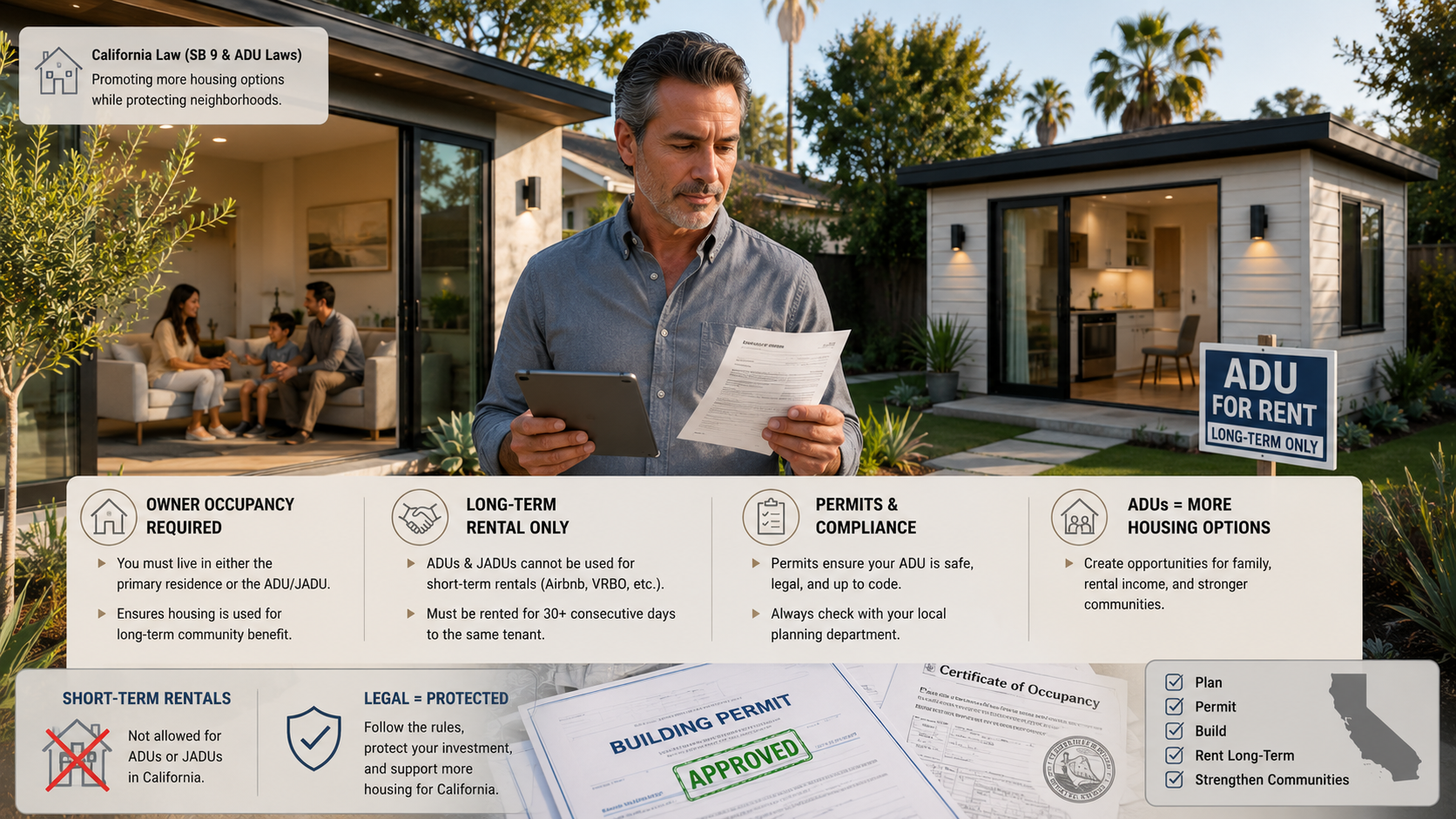
!Owner-occupancy and rental rules in California
When comparing JADU vs ADU California rules, owner-occupancy is often the biggest practical difference.
For a JADU, the property owner must live on the property. The owner can occupy either:
- the main home
- the JADU
ADU rules are different. Under the current statewide waiver period, many newly permitted ADUs do not require owner occupancy. However, California ADU regulations have changed several times in recent years and may change again, so homeowners should always verify current local requirements with their city before permitting.
Short-term rental restrictions also vary by municipality for both ADUs and JADUs. Some California cities prohibit or limit short-term rentals for accessory dwelling units.
For many homeowners, this becomes the deciding factor between ADU vs JADU projects:
- JADUs are often better suited for multi-generational living or owner-occupied properties
- ADUs usually provide more flexibility for long-term rental use and independent living arrangements
Cost and Timeline Differences
In most California projects, a JADU is significantly less expensive than an ADU because it converts existing interior space instead of requiring full new construction.
For homeowners comparing JADU vs ADU options, project costs generally scale by construction type:
- lowest cost: interior conversions or garage conversion ADUs
- mid-range cost: attached ADUs
- highest cost: detached ADUs with new foundations, utilities, and structural framing
Construction timelines follow a similar pattern. A JADU often finishes in a fraction of the time required for a detached ADU because the project works within the existing structure of the home and usually involves less site work and fewer utility upgrades.
For many homeowners evaluating the difference between ADU and JADU projects, budget and timeline become the deciding factors between a smaller conversion project and a fully independent living unit.
Permitting and California Law
California has simplified ADU and JADU approvals in recent years through statewide housing laws that limit how cities can restrict accessory dwelling units.
Under current California law:
- many ADU and JADU applications must be approved ministerially within 60 days after a complete application is submitted
- AB 2221 allows side and rear setbacks of up to four feet for many ADU projects
- most single-family properties may qualify for one ADU and one JADU on the same lot, subject to local zoning and site conditions
- cities cannot impose owner-occupancy requirements on many ADUs permitted during the current statewide waiver period
- cities may still require owner occupancy for JADUs
Even with statewide ADU reforms, local governments still control parts of the permitting process, including height limits, utility requirements, historic review, and some design standards.
Because local implementation can vary between California cities, homeowners should confirm current ADU and JADU requirements with their local planning department before starting design or permitting.
Can You Build Both an ADU and a JADU on the Same Lot?
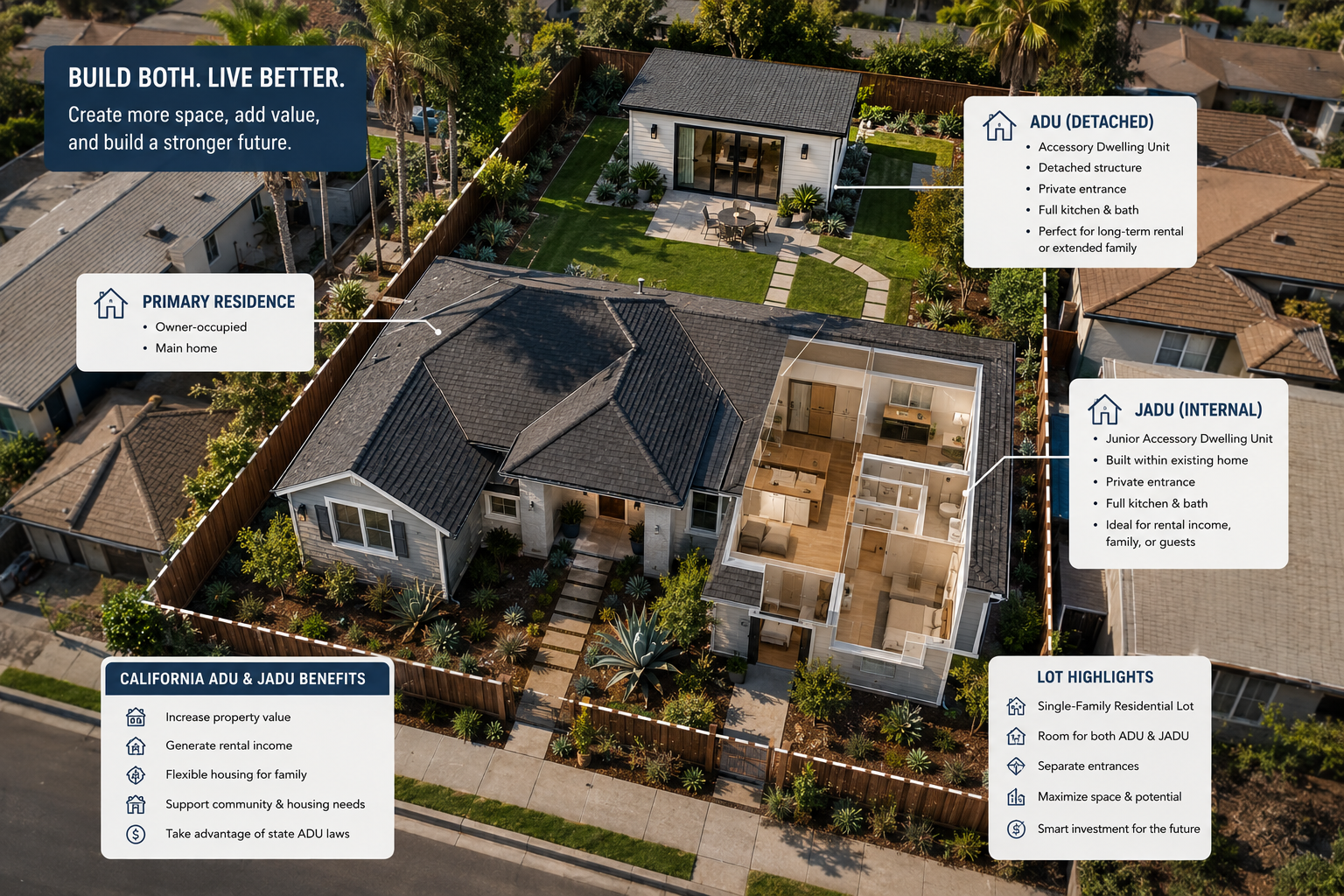
In many California single-family zones, homeowners may be allowed to build both one ADU and one JADU on the same property, subject to local zoning, lot conditions, and permitting requirements.
A common layout includes:
- a detached ADU located in the rear yard
- a JADU created from space inside the existing primary home
Some homeowners use this setup for multi-generational living, such as housing parents, adult children, or extended family members on the same property. Others use one unit for long-term rental income while keeping the second unit owner-occupied.
For homeowners comparing ADU and JADU options, combining both unit types can create more flexible living arrangements without purchasing a larger property.
How to Choose: JADU or ADU?
Choose a JADU If…
- you have a limited budget
- you want to keep the project smaller and simpler
- you are comfortable with California’s owner-occupancy requirement
- you only need extra living space for family members or guests
- you plan to convert existing interior space within the home
For many homeowners comparing the difference between ADU and junior ADU options, a JADU works best for smaller family-focused living arrangements rather than fully independent housing.
Choose an ADU If…
- you want a fully independent rental unit
- you need more privacy and separation from the main home
- you have yard space for a detached structure
- you want more long-term flexibility
- you may refinance based on added living space and property functionality
When comparing JADU vs ADU projects, ADUs generally provide more independence, while JADUs offer a smaller and more cost-efficient conversion option.
Garage conversions often work as the middle-ground option between junior ADU vs ADU projects, depending on the layout, utilities, and level of separation from the main residence.
Frequently Asked Questions
!Frequently asked questions about JADU vs ADU
What is the main difference between a JADU and an ADU in California?
The biggest difference between a JADU and an ADU is size and independence. A JADU must be created within an existing single-family home and is limited to 500 square feet under California law. An ADU can be detached, attached, or converted from existing space and may reach up to 1,200 square feet in many jurisdictions, subject to local rules. ADUs also require a full kitchen and private bathroom, while JADUs may share a bathroom with the primary residence.
How big can a JADU be compared to an ADU?
California limits JADUs to a maximum of 500 square feet. ADUs can often be significantly larger depending on local zoning standards, lot conditions, and the type of ADU being built. In many California cities, ADUs may be large enough to include one or two bedrooms, while JADUs are usually designed as studio-style living spaces.
Do I have to live on the property if I build a JADU or an ADU?
For a JADU, generally yes. Under current California law, the property owner is typically required to live either in the primary home or in the JADU itself. Many newly permitted ADUs are currently exempt from statewide owner-occupancy requirements during the present waiver period, although local implementation rules may still vary. Homeowners should confirm current requirements with their local planning department before permitting.
Can I build both a JADU and an ADU on the same lot?
In many California single-family zones, homeowners may be allowed to build one ADU and one JADU on the same property, subject to local zoning and site conditions. A common layout includes a detached backyard ADU combined with a JADU converted from part of the existing home.
Is a JADU cheaper to build than an ADU?
In most cases, yes. JADUs are usually less expensive because they reuse existing interior space and typically require less structural work than a detached ADU. Detached ADUs are generally the highest-cost option because they often involve new foundations, utility connections, framing, and site work.
How long does it take to get a JADU or ADU permit approved in California?
Under current California law, many ADU and JADU applications must be reviewed ministerially within 60 days after a complete application is submitted. Actual approval timelines can still vary depending on the city, project revisions, utility coordination, and overall project complexity.
Final Thoughts
Choosing between a JADU and an ADU depends on how you plan to use the space, your budget, and how independent the unit needs to be long term.
For many California homeowners, a JADU works well for smaller family-focused living space within the existing home, while an ADU offers more flexibility for independent living, rental use, or detached construction.
Understanding California’s current size limits, owner-occupancy rules, and permitting requirements early can help make the planning process more predictable.
Heroes Services works with Bay Area homeowners on ADUs, garage conversions, and home remodeling projects. If you are still comparing JADU vs ADU options, a property-specific feasibility review can help clarify what may work best for your lot and long-term goals.