

Rose M.
Introduction
San Francisco ADU rules are more complex than the statewide guidelines many homeowners first encounter online. While California ADU laws set the foundation, San Francisco adds its own Planning Code requirements, permit procedures, tenant protections, and property-specific eligibility rules that can affect whether an ADU project qualifies and how long approvals take.
This ADU San Francisco guide explains how the local process works, including eligibility requirements, the San Francisco accessory dwelling unit permit process, and the differences between the Local ADU Program and the State/Waiver Program. It also covers the planning steps that often help homeowners avoid delays, redesigns, and permitting issues before construction begins.
Whether you are planning a garage conversion, basement unit, or detached backyard ADU in San Francisco, understanding the city’s permitting and zoning process early can make the project more predictable from design through final approval.
What Is an ADU in San Francisco?
!What is an ADU in San Francisco
An ADU, or accessory dwelling unit, is a secondary residential unit built on the same property as an existing home or residential building. In San Francisco, ADUs are also commonly referred to as in-law units, secondary units, granny flats, or backyard cottages.
A San Francisco ADU functions as an independent living space with its own kitchen, bathroom, and entrance. Homeowners commonly use an ADU in San Francisco for long-term rental housing, multigenerational living, guest space, or additional residential flexibility.
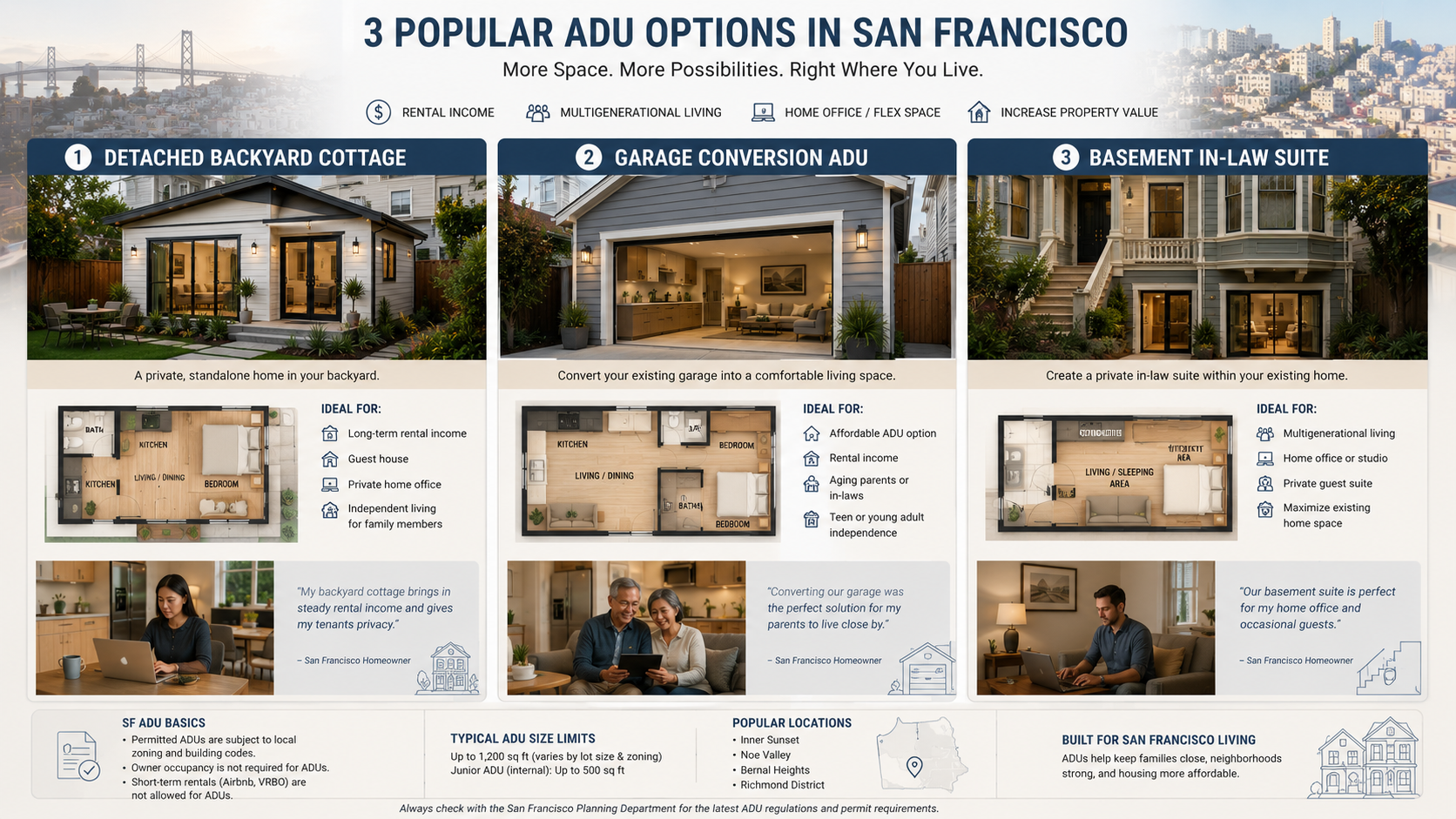
The four most common accessory dwelling unit San Francisco project types are:
- detached new-build ADUs
- attached additions
- basement or garage conversions
- conversion of underutilized interior space
Because many San Francisco properties have limited lot space and dense urban layouts, basement, garage, and interior conversions are especially common throughout the city.
San Francisco ADU regulations build on top of California state ADU law and add additional city-specific Planning Code requirements. Depending on the property, homeowners may also need to consider rear-yard requirements, exposure standards, tenant protections, rent-control history, prior eviction restrictions, and existing legal unit count.
For homeowners researching ADU San Francisco requirements, understanding these local layers early can help reduce redesigns, permitting delays, and eligibility issues later in the planning process.
San Francisco ADU Requirements at a Glance
!San Francisco ADU requirements at a glance
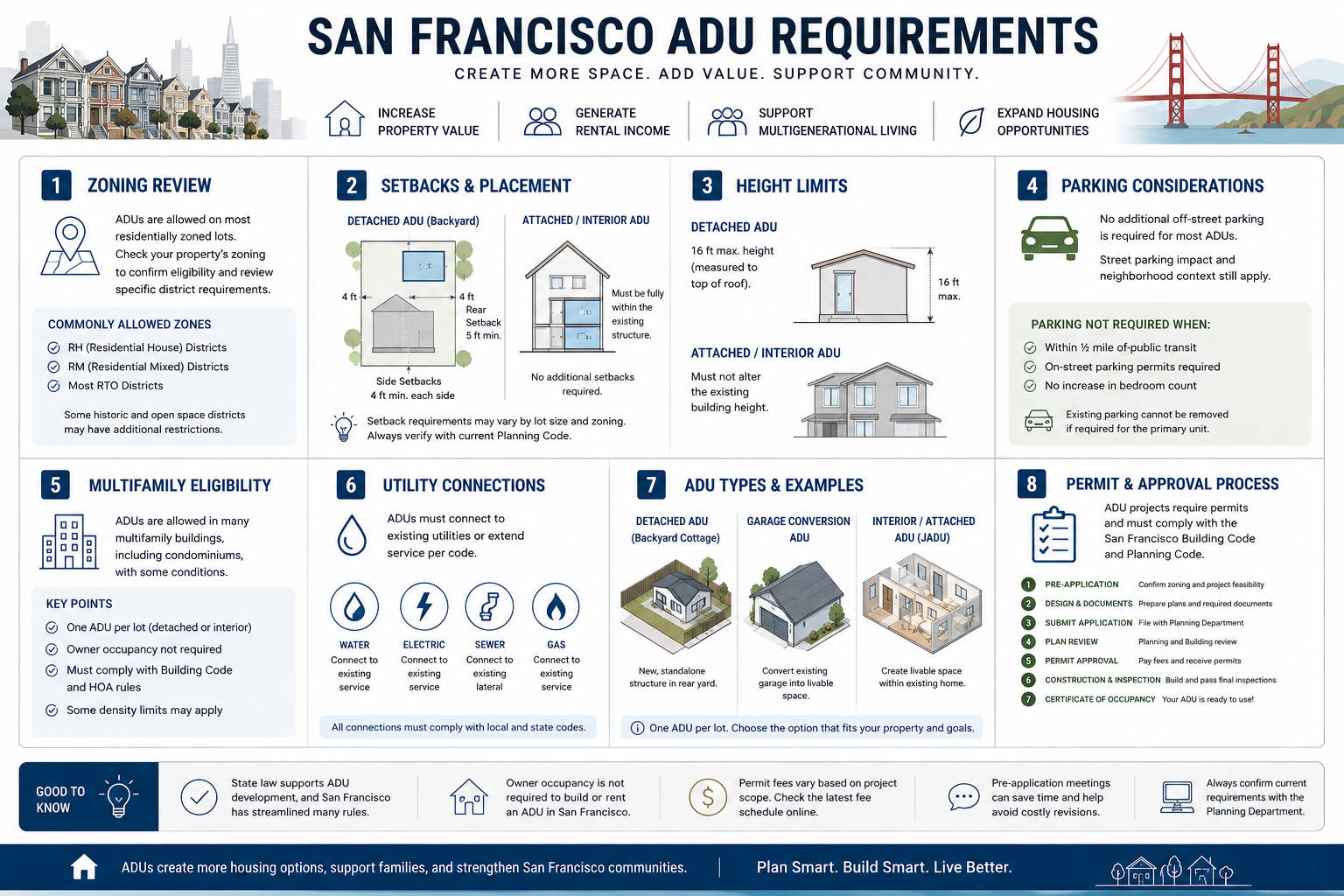
Before starting design work, homeowners should confirm that the property qualifies under current ADU requirements San Francisco regulations.
Most residentially zoned properties in San Francisco may qualify for an ADU, but the rules differ between single-family homes and multifamily buildings. In multifamily properties, the number of permitted ADUs is typically tied to the building’s existing legal unit count and whether the project falls under the Local ADU Program or the State/Waiver Program.
San Francisco ADU regulations also consider tenancy and building history. Properties with certain no-fault eviction history — including some Ellis Act or owner move-in evictions within specific lookback periods — may face restrictions on ADU development. Existing rent-controlled units can also affect project eligibility, especially when converting garages, storage areas, or other shared building space into housing.
Several San Francisco accessory dwelling unit regulations are commonly overlooked during early planning:
- ADUs cannot generally be used as short-term rentals
- ADUs typically cannot be sold separately from the primary property
- Condo-conversion limitations may apply
- Tenant notification requirements may apply in occupied multifamily buildings
Quick Eligibility Snapshot
- Property is located in a residential zoning district
- Existing legal unit count is properly documented
- Single-family and multifamily properties follow different ADU rules
- No disqualifying no-fault eviction history applies
- Proposed ADU complies with long-term residential use requirements
For homeowners researching San Francisco ADU requirements or ADU regulations San Francisco, these zoning, tenancy, and building-history rules are often just as important as the physical design itself. Because requirements can vary by property and building history, homeowners should confirm project-specific eligibility with SF Planning, the Rent Board, or a qualified ADU professional before starting the permit process.
Local Program vs. State (Waiver) ADU Program
San Francisco homeowners building an ADU in San Francisco typically choose between the Local ADU Program and the State/Waiver ADU Program. The difference mainly comes down to Planning Code compliance, waiver eligibility, and review process.
| Feature | Local ADU Program | State/Waiver ADU Program |
| --- | --- | --- |
| Review Process | Standard Planning Code review | Ministerial review |
| Neighborhood Notice | Posted 15 days before submittal | Generally not required unless variances or certain expansions apply |
| Waivers Available | Limited | Rear yard, parking, open space, density, exposure, bicycle parking, and 25% conversion cap |
| Common Property Type | Code-compliant projects | Multifamily buildings and constrained lots |
The Local Program is generally used for projects that already comply with standard San Francisco accessory dwelling unit regulations. The State/Waiver Program is more commonly used for multifamily buildings and single-family homes that need waivers from standard Planning Code requirements.
For homeowners researching ADU regulations San Francisco or building an ADU in San Francisco, this choice can affect permitting timeline, design flexibility, construction scope, and overall project complexity.
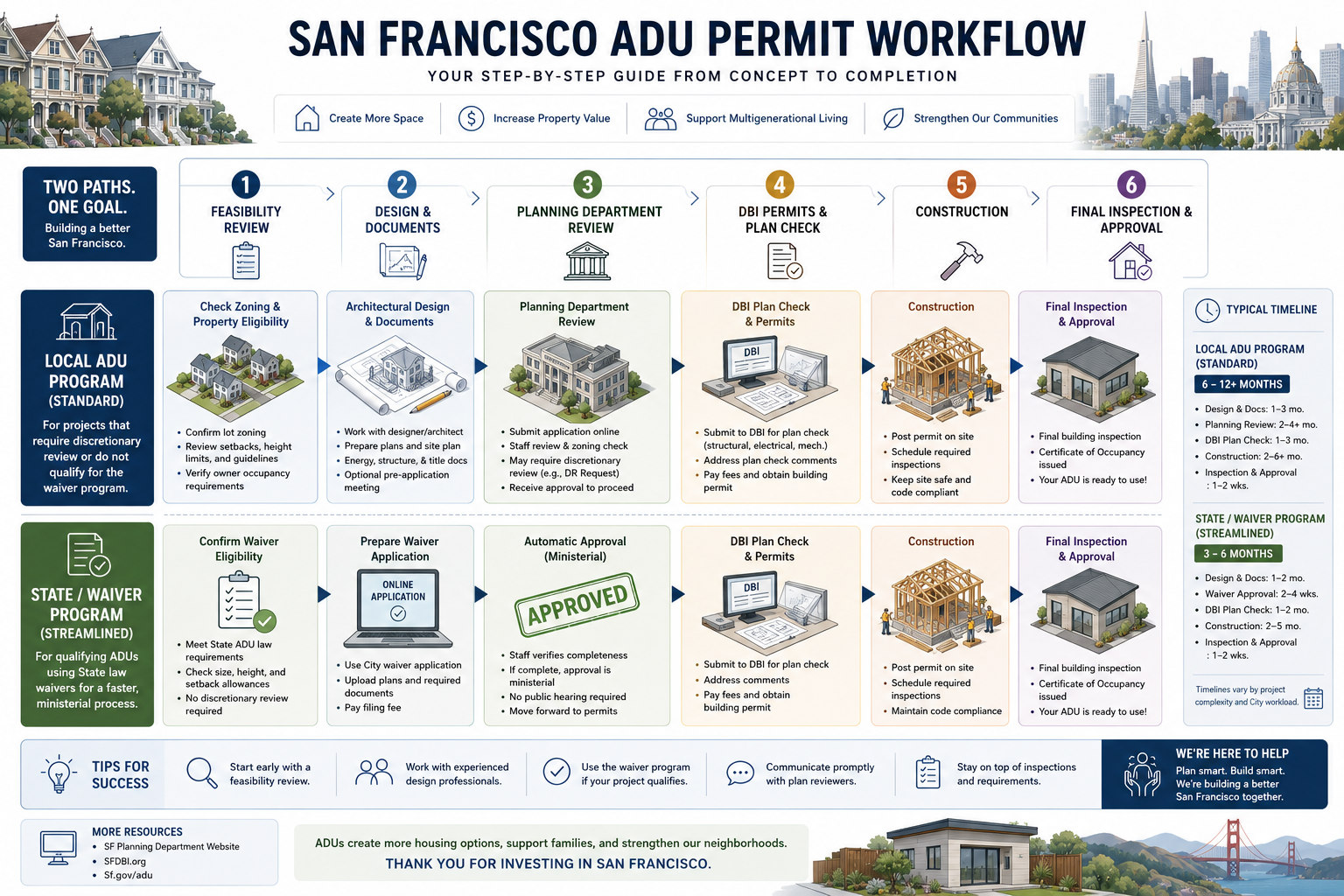
The San Francisco ADU Permit Process: Step-by-Step
- Step 1: Confirm Property Eligibility: Review zoning, eviction history, rent-control status, and existing legal unit counts to confirm the property qualifies under current San Francisco ADU permit requirements.
- Step 2: Choose the Program Track: Determine whether the project fits the Local ADU Program or the State/Waiver ADU Program based on Planning Code compliance and waiver needs.
- Step 3: Schedule a Permit Review Roundtable: State/Waiver Program ADUs may go through a Permit Review Roundtable, which provides an advance virtual review with multiple city departments before formal submittal.
- Step 4: Hire a Designer or Design-Build Contractor: Finalize architectural plans, structural drawings, and permit-ready documents before submission.
- Step 5: Address San Francisco Plan-Set Requirements: Plans must include San Francisco-specific details such as street tree placement. In many cases, the city requires one street tree per 20 feet of frontage.
- Step 6: Post the 15-Day Notice: Projects using the Local ADU Program must post a neighborhood notice 15 days before submitting the permit application.
- Step 7: Submit the ADU Permit Application: Submit plans and supporting documents through the San Francisco ADU permitting process.
- Step 8: Complete Plan Check and Corrections: Projects move through departmental review, correction cycles, and approval. Complete ministerial applications may move through review in roughly four months, while projects involving variances or expansions often take longer.
- Step 9: Pull the Building Permit and Begin Construction
Once approved, the building permit is issued and construction can begin.
- Step 10: Complete Required Inspections: Inspection stages typically include foundation, framing, rough mechanicals, insulation, and final inspection.
- Step 11: Receive Final Occupancy Approval: After passing final inspection, the city issues final occupancy clearance for the ADU.
ADU Construction in San Francisco: What to Expect
ADU construction San Francisco projects often involve higher construction complexity than many other California markets because of dense lot conditions, older building stock, and stricter site constraints.
What Increases ADU Construction Costs in San Francisco?
Several factors can increase the cost of building an ADU in San Francisco, especially on older or constrained properties. Common cost drivers include tight site access on narrow lots, hillside excavation, soft-story retrofit conditions, utility upgrades, and higher finish levels.
Because of these site and structural challenges, per-square-foot construction costs in San Francisco often fall into higher pricing tiers than statewide averages, particularly for detached ADUs, hillside properties, or multifamily buildings requiring structural reinforcement.
Typical ADU Construction Phases in San Francisco
Most San Francisco ADU projects move through the same core construction stages:
- site preparation and demolition
- foundation and structural work
- framing
- electrical, plumbing, and HVAC installation
- insulation and interior finishes
- final inspections and occupancy approval
In older buildings, delays sometimes occur when hidden structural conditions, outdated utilities, or difficult access conditions are discovered during construction.
Pre-Approved ADU Plans vs. Custom ADU Construction
Some homeowners choose pre-approved detached ADU plans because they can simplify portions of the review process and reduce design time compared to fully custom projects.
Others pursue custom ADU construction in San Francisco CA to better fit the property layout, long-term rental goals, or multigenerational living needs. Custom designs often require closer attention to ceiling height requirements, property-line distances, rear-yard limitations, and San Francisco light and exposure standards.
For homeowners researching adu construction San Francisco or building an ADU in San Francisco, these site-specific construction and design factors often have a major impact on permitting complexity, construction scope, and overall project timeline.
Common SF ADU Pitfalls to Avoid
Several avoidable mistakes can delay approvals or create compliance problems during the San Francisco ADU permitting process.
- Choosing the wrong program track: Some projects enter the Local ADU Program even though the property would benefit from the flexibility of the State/Waiver Program. This can limit design options and extend review timelines.
- Missing the 15-day notice requirement: Local Program projects must post a neighborhood notice at least 15 days before permit submittal. Missing this requirement can delay the application process.
- Overlooking non-waivable Planning Code items: Some San Francisco ADU requirements still apply even under the Waiver Program, including certain street tree, permeability, and landscaping requirements.
- Ignoring rent-control and tenancy impacts: Converting garage, laundry, or storage areas in occupied multifamily buildings can trigger rent-control and just-cause tenancy issues. Property owners should review tenant protections carefully before starting design work.
- Skipping the Permit Review Roundtable on complex projects: Complex State/Waiver Program projects often benefit from an early Permit Review Roundtable to identify Planning or code issues before formal submittal.
For homeowners researching adu regulations San Francisco or San Francisco ADU requirements, these planning and compliance issues are often the biggest causes of redesigns, permit delays, and unexpected project complications.
How to Plan a San Francisco ADU Project?
Good planning early in the process can help reduce permitting delays, redesigns, and construction complications during an ADU San Francisco project.
- Define how the ADU will be used: Some homeowners build an ADU in San Francisco for rental income, while others prioritize multigenerational housing, home office space, guest housing, or long-term flexibility for future family needs.
- Set a realistic project budget: Most ADU projects include design, permitting, engineering, construction, utility work, and inspection costs. Detached ADUs, hillside sites, and multifamily buildings often fall into higher construction tiers because of structural and site complexity.
- Understand common financing options: Many homeowners use HELOCs, cash-out refinancing, or construction loans to fund ADU construction San Francisco projects.
- Plan for San Francisco permitting timelines: Design and permitting often take several months before construction begins. Construction timelines can also vary based on property access, structural upgrades, and permit review complexity.
- Choose a contractor or design team with San Francisco ADU experience: San Francisco Planning and DBI review processes are highly specific. Working with a team experienced in local ADU permitting can help avoid common compliance and plan-review issues.
- Verify licensing, insurance, and local project experience: Before hiring a contractor or design-build team, homeowners should confirm licensing, insurance coverage, and previous San Francisco ADU project experience, especially on older buildings or constrained urban lots.
Can You Sell or Rent Out an SF ADU?
Long-term rentals are generally allowed for ADUs in San Francisco, which is one reason many homeowners pursue these projects for rental income or multigenerational housing. However, San Francisco accessory dwelling unit regulations generally prohibit using ADUs as short-term rentals.
In most cases, a San Francisco ADU cannot be sold separately from the primary property. Limited Planning Code exceptions may apply in narrow situations, but separate ownership is generally restricted under current adu regulations San Francisco rules.
Condo conversions are also limited. Some properties that completed qualifying seismic-retrofit work may preserve certain condo-conversion rights, but these cases are highly property-specific.
Because tenancy, ownership, and condo-conversion rules can involve SF Planning, Rent Board regulations, and legal requirements, homeowners should consult a qualified attorney or local agency before making rental, ownership, or conversion decisions for an ADU in San Francisco.
Frequently Asked Questions
!Frequently asked questions about San Francisco ADUs
Do I need a permit to build an ADU in San Francisco?
Yes. A legal ADU in San Francisco requires permits and review through SF Planning and the Department of Building Inspection. Depending on the project, homeowners may apply through either the Local ADU Program or the State/Waiver Program.
How long does the San Francisco ADU permit process take?
The timeline depends on the project scope and approval pathway. Complete State/Waiver Program applications may move through ministerial review in roughly four months, while projects involving variances, expansions, or major corrections often take longer. Design development, plan revisions, and inspections can extend the overall timeline before construction begins.
What’s the difference between SF’s Local ADU and Waiver Program?
The Local Program follows standard San Francisco Planning Code requirements and requires a posted 15-day neighborhood notice before application submittal. The State/Waiver Program follows a ministerial review process and may allow waivers for rear yard, parking, open space, exposure, bicycle parking, density, and the 25% conversion cap.
Can I rent out an ADU in San Francisco?
Yes. Long-term rentals are generally allowed for ADUs in San Francisco. However, ADUs generally cannot be used as short-term rentals. Homeowners with rent-controlled or tenant-occupied buildings should review local tenancy requirements before starting the project.
Can I sell an ADU separately from my main home in San Francisco?
In most cases, no. A San Francisco ADU is typically tied to the primary property and cannot be sold separately. Limited condo-conversion exceptions may apply in certain seismic-retrofit situations, so homeowners should consult a qualified attorney for property-specific guidance.
How many ADUs can I build on my San Francisco property?
The answer depends on zoning, lot conditions, and whether the property is single-family or multifamily. Multifamily buildings may qualify for multiple ADUs based on the number of existing legal units, especially under the State/Waiver Program. A zoning and eligibility review can help clarify what the property may support.
Closing Thoughts
Building an ADU in San Francisco involves more than design and construction. Zoning rules, permit pathways, tenant protections, and property-specific Planning requirements can all affect what is realistically possible on a site.
Whether you are planning a garage conversion, detached backyard unit, or multifamily ADU project, understanding the San Francisco ADU permitting process early can help reduce redesigns, permit delays, and unexpected construction issues later.
Hero Services works with homeowners across San Francisco and the Bay Area on ADU and remodeling projects shaped around real property constraints, long-term goals, and current San Francisco accessory dwelling unit regulations. If you are considering building an ADU in San Francisco, reviewing the property, permit pathway, and eligibility requirements early is often the best place to start.